LinkedIn Ads for B2B: get high-quality leads and maximize ROI
Every Monday morning, a familiar battle unfolds in the boardrooms of growing businesses. The Chief Marketing Officer presents an aggressive strategy to capture high-value enterprise clients, while the Chief Financial Officer immediately pushes back, pointing at the notoriously high LinkedIn Ads cost compared to other social channels. Meanwhile, the IT Director raises critical concerns about CRM data hygiene and compliance with strict state-level privacy laws, especially when managing cross-border data flows with Latin American prospects.
This interdepartmental friction usually ends in a costly compromise: running generic, broad-match campaigns on cheaper, consumer-focused platforms. The result? A pipeline full of unqualified leads that the sales team actively ignores. A poorly designed lead generation funnel is the digital equivalent of a massive logistics bottleneck; your prospects are stuck, your operational bandwidth is exhausted, and your revenue is left waiting.
In 2026, treating LinkedIn Ads as just another discretionary social media expense is a critical operational failure. The market is simply too valuable for scattergun approaches. LinkedIn is a surgical precision tool designed to bypass corporate gatekeepers and land your value proposition directly on the screens of decision-makers who hold the budget.
Why LinkedIn Ads are the B2B lead generation engine in 2026
Understanding the unique B2B advantage of LinkedIn Ads
B2B purchasing decisions are rarely driven by impulse or flashy aesthetics; they are driven by rigorous risk mitigation. According to recent behavioral insights from the Marketing & Advertising Blog | LinkedIn for Marketing Blog, complex B2B buying is heavily influenced by the “fear of messing up.” Decision-makers aren’t just looking for a list of software features; they are actively seeking collective confidence to get their entire buying committee on board without risking their professional reputation.
When you deploy LinkedIn Ads for B2B, you are intercepting professionals precisely when they are in a mindset of problem-solving and career advancement. They aren’t scrolling their feed to be entertained by viral trends; they are actively seeking tangible solutions to operational bottlenecks, compliance risks, and revenue stagnation.
Beyond the basics: how LinkedIn Ads deliver high-quality leads
The most common objection from finance departments is the raw Cost Per Lead (CPL). However, comparing, for example, a $5 lead from a generic social platform with a $40 lead from LinkedIn can be misleading. A cheap lead that never converts and wastes your sales team’s time can ultimately be more expensive than a premium lead that signs a multi-year enterprise contract.
You are not paying for reach; you are paying a premium to filter out the noise. Instead of casting a wide net and hoping a CEO accidentally swims into it, you are buying direct access to the virtual boardroom.
Key benefits for B2B marketers: from awareness to conversion
To justify this investment to a skeptical CFO, you must map the platform’s technical capabilities directly to tangible business outcomes. Currently, 78% of B2B CMOs say demonstrating ROI is more critical now than ever before. LinkedIn achieves this through:
- Surgical targeting: Reach exact job titles, company sizes, and seniority levels, reducing irrelevant impressions and helping you reach the roles involved in the buying decision.
- Frictionless lead capture: Native Lead Gen Forms remove the need for slow-loading external landing pages, using pre-filled professional profile information to reduce form friction.
- Full-funnel attribution:
Direct API integrations can connect campaign data with CRM outcomes to better understand pipeline and revenue impact.
Mastering your audience: precise targeting for high-quality LinkedIn Ads leads
Leveraging LinkedIn’s data: professional demographics and behaviors
If your targeting strategy relies solely on broad parameters like “Age 30-50” and “Lives in Texas or Florida,” you are actively burning cash. LinkedIn’s true power lies in its proprietary professional graph. You can segment audiences by specific member skills, active groups, and even company growth rates.
For instance, if your firm provides digital transformation consulting, you don’t just target “IT managers.” You target CIOs in Latino-owned businesses, a demographic that grew 44% over a five-year span and is heavily focused on AI integration. You target companies with 500+ employees that are actively hiring for machine learning engineers, signaling a readiness to buy.
Account-Based Marketing (ABM) flips the traditional lead generation funnel upside down. Instead of trying to attract a broad audience and filtering them later, you upload a highly specific list of target companies (e.g., the top 100 cross-border logistics firms operating between Monterrey and Laredo). LinkedIn matches these exact companies, allowing you to serve ads exclusively to their internal buying committees. This can reduce wasted spend and make messaging more relevant to target accounts.
Custom audiences and lookalikes: expanding your reach smartly
A prospect who visits your enterprise pricing page and leaves without converting is a warm lead left out in the cold. By implementing the LinkedIn Insight Tag across your site, you build custom retargeting audiences based on high-intent actions. Once you have a segment of high-converting users, you deploy Lookalike Audiences to find new professionals with identical behavioral and demographic footprints, scaling your reach without sacrificing lead quality.
Crafting compelling campaigns: LinkedIn Ads formats and creative strategies
Exploring effective LinkedIn Ads formats: sponsored content, message ads, and more
Not all ad formats serve the same strategic purpose. Deploying the wrong format at the wrong funnel stage can significantly hurt campaign performance.
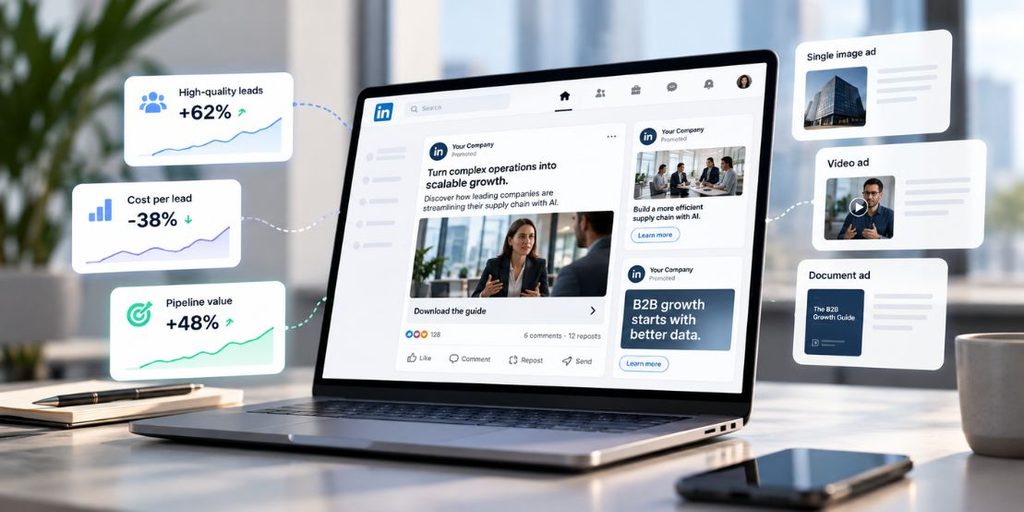
- Single Image Ads: Best for quick, data-driven insights and top-of-funnel brand awareness.
- Document Ads: Perfect for gating high-value whitepapers directly in the feed, allowing users to read the first few pages before submitting their email.
- Thought Leader Ads: Can be particularly valuable for B2B campaigns because they allow companies to amplify content from individual voices rather than relying exclusively on corporate messaging.
This format allows companies to sponsor organic posts from their executives’ personal profiles. Data shows that 73% of B2B decision-makers say thought leadership is a more trustworthy basis for assessing a company. For example, instead of your corporate page posting a generic “We offer cross-border logistics” ad, sponsor a post from your Logistics CEO detailing exactly how they navigated a 48-hour customs gridlock at the Port of Laredo using predictive routing. This leverages human-to-human trust rather than faceless corporate broadcasting.
The art of ad copy: engaging your B2B prospect
Your ad copy must agitate a highly specific operational pain point and offer a clear, immediate resolution. Generic phrases like “We provide innovative solutions for your business” are completely invisible to busy executives. To demonstrate how to bypass writer’s block and generate high-converting, hyper-targeted copy, here is an exact prompt engineering framework you can use with your internal AI tools:
Hyper-local Persona Prompt:
“Act as a Senior B2B Copywriter. Write a 40-word LinkedIn Sponsored Content ad targeting Supply Chain Directors at US Hispanic companies dealing with cross-border imports. Agitate the specific logistical friction of customs delays at the Port of Laredo. Position our predictive analytics software as the exact solution to prevent costly inventory stockouts. Use a direct, authoritative tone. No hashtags. Focus on ROI.”
Visual storytelling: creative best practices for LinkedIn Ads
Visuals must stop the scroll, but the embedded data must close the click. Avoid generic stock photos of people shaking hands in brightly lit boardrooms, they signal low effort and trigger ad blindness. Instead, use high-contrast data infographics, actual platform UI screenshots, or raw 15-second video case studies featuring your clients. Map your CPL reduction over six months into a waterfall chart to visualize efficiency gains directly in the feed. The visual must instantly communicate the financial or operational ROI of your solution.
Benchmarking success: insights from the LinkedIn Ad Library
Never launch a campaign based on assumptions. The linkedIn Ad Library is an underutilized goldmine for competitive intelligence. Search for your top three direct competitors and analyze their active ad inventory. What specific calls to action (CTAs) are they testing? Are they leaning heavily into video or carousel formats? Use this radical transparency to benchmark your creative approach, identify messaging gaps in your specific niche.
Optimizing for profitability: maximizing ROI with LinkedIn Ads performance
Managing your budget: understanding LinkedIn Ads cost and bidding strategies
To align with your finance team’s strict profitability expectations, you must master the mechanics of bidding. Choosing the wrong bidding strategy can exhaust your monthly budget in a matter of days with zero return. Marketing Directors must understand the nuances of how the algorithm spends their money.
| Bidding Strategy | Best Used For | Cost Control Level | Algorithm Behavior |
|---|---|---|---|
| Maximum Delivery | New campaigns needing baseline data and fast reach | Low | Spends the full daily budget aggressively to get maximum results, regardless of individual click cost. |
| Cost per Result | Strict CPA requirements mandated by the CFO | High | Paces delivery tightly to stay under your target cost per lead. May under-deliver if the bid is too low. |
| Enhanced CPC | Manual control with AI optimization | Medium | Allows manual bid setting but gives the AI permission to adjust bids dynamically based on conversion likelihood. |
A/B testing your way to better conversions
Do not test five variables at once; this pollutes your data. Run strictly isolated A/B tests. Keep the creative asset identical and test two fundamentally different headlines (e.g., one focusing on risk aversion and compliance, the other on aggressive revenue growth). Even relatively small CTR improvements can contribute to better campaign efficiency, although the impact on CPC, CPM and CPL will vary.
Continuous optimization: monitoring campaign metrics and adjusting
Set up automated rules directly within LinkedIn Campaign Manager. If an ad’s frequency surpasses 4.0 (meaning the same person has seen it four times) and the CTR drops below 0.35%, configure the system to pause it automatically to prevent ad fatigue. Shift budget dynamically toward the specific demographics (e.g., Seniority: VP and above) that are actually submitting lead forms, rather than those just clicking and bouncing.
Beyond the click: tracking, reporting, and scaling your LinkedIn Ads success
Setting up conversion tracking for accurate ROI measurement
A high-performing ad is only one part of the conversion journey. If you direct a premium LinkedIn click to a generic, slow-loading homepage, you are actively burning your budget. A robust post-click funnel requires a dedicated landing page stripped of top navigation, heavily focused on a single conversion action.
Key landing page elements must include:
- Hyper-relevant Social Proof: Don’t just paste generic company logos. If your ad targeted SaaS CFOs, the landing page must feature a text-heavy testimonial from a SaaS CFO highlighting specific financial metrics achieved.
- High-Value Lead Magnets: B2B buyers will not trade their corporate email for a superficial checklist. Offer proprietary data, such as a “2026 US Hispanic Market Supply Chain Benchmark Report.”
- Progressive Profiling: Use enterprise tools like HubSpot or Marketo to ask for different information each time a prospect interacts with your forms. This keeps friction low on the first touchpoint while building a rich CRM profile over time.
Once the lead is captured, the handoff to sales must be seamless, supported by an automated 3-step email nurturing sequence:
- Email 1 (Immediate Delivery) – The Value Fulfillment: Deliver the promised asset immediately. Keep it text-heavy and personal, coming from a specific executive’s email address, not a generic “noreply@”.
- Email 2 (Day 3) – The Friction Agitator: Identify a common operational bottleneck related to the downloaded asset. For example, “Most supply chain directors we speak with struggle to integrate this cross-border data with their legacy ERP.” Offer a 5-minute video walkthrough of how your platform solves this exact issue.
- Email 3 (Day 7) – The Soft Pitch & Proof: Share a micro-case study of a similar company that achieved a measurable ROI using your solution. End with a low-friction call to action: “Are you open to a 10-minute technical audit next Tuesday?”
Furthermore, ensure your tracking complies with regional data laws by configuring GA4 consent modes properly, satisfying your IT Director’s compliance requirements.
Interpreting campaign performance: key metrics for B2B
Move past vanity metrics like impressions and likes. For B2B campaigns, three particularly useful business metrics are:
- Cost Per Qualified Lead (CPQL): How much does it cost to acquire a lead that the sales team actually accepts and works?
- Sales Qualified Lead (SQL) Win Rate: What percentage of these LinkedIn leads turn into closed revenue?
- Return on Ad Spend (ROAS): How much revenue do your LinkedIn Ads generate relative to your media investment?
Scaling what works: expanding your most successful LinkedIn Ads campaigns
Increase budgets gradually while monitoring cost per qualified lead, conversion volume and downstream sales quality. Scaling too fast resets the algorithm’s learning phase and spikes your costs. Simultaneously, scale horizontally by introducing Lookalike audiences based strictly on your closed-won deals, not just website visitors.
Future-proofing your strategy: what’s next for LinkedIn Ads in B2B marketing
Emerging trends and features for LinkedIn Ads in 2026
The landscape of B2B acquisition is shifting rapidly. LinkedIn’s Predictive Audiences is fundamentally changing how we approach targeting. Instead of relying purely on static job titles, the algorithm now analyzes real-time intent signals such as whitepaper consumption patterns, virtual event attendance, and engagement with specific industry hashtags, to dynamically build audiences that are actively in-market.
Coupled with AI-generated creative variations, these predictive models are pushing average CTR benchmarks higher. As Chartis analyzed, top-performing B2B ads in SaaS and Manufacturing now outperform the old 0.89% industry average. This demands that marketing directors continuously refresh their visual assets using AI tools to prevent ad fatigue and maintain competitive engagement rates.
Integrating LinkedIn Ads with your broader marketing stack
LinkedIn cannot operate in a silo. If a prospect downloads a technical whitepaper via a LinkedIn Lead Gen form, that action must trigger a specific email nurturing sequence in Salesforce or HubSpot, while simultaneously alerting the assigned sales representative via a Slack integration. This closed-loop system ensures speed to lead, which is critical for conversion.
Final thoughts: sustaining B2B lead generation excellence
Transforming your digital pipeline requires more than just increasing your daily ad spend; it requires strict strategic alignment between marketing, sales, and finance. By leveraging deep micro-segmentation, respecting local regulatory and operational frictions, and maintaining rigorous CRM hygiene, you turn a perceived expense into a predictable, scalable revenue engine.
Talk to our team about your LinkedIn Ads strategy.
Frequently Asked Questions (FAQ)
What is a good CTR for LinkedIn Ads in the B2B sector?
A healthy Click-Through Rate (CTR) for Sponsored Content typically ranges between 0.4% and 0.6%. However, with predictive audiences in 2026, anything above 0.9% indicates highly relevant targeting and exceptional creative alignment.
How can I lower my overall LinkedIn Ads cost without losing quality?
Focus relentlessly on increasing your CTR through hyper-relevant ad copy and isolated A/B testing. A higher CTR improves your ad relevance score, which forces the LinkedIn algorithm to lower your Cost Per Click (CPC) and Cost Per Mille (CPM).
Should I use native Lead Gen Forms or direct traffic to my website?
For bottom-of-the-funnel offers (like demos or consultations), native Lead Gen Forms convert at a significantly higher rate because they remove friction and auto-fill the user’s professional data. Use website traffic campaigns for complex products that require heavy education on a dedicated, high-converting landing page.
How do I spy on competitors using the LinkedIn ad library?
Navigate to the LinkedIn Ad Library, search by your competitor’s exact corporate name, and filter by country or region. You will see all their active ad inventory, allowing you to analyze their messaging, visual formats, and calls to action without spending a dime of your own budget.